
Morocco driving rules & road signs foreigners should know

Key takeaways
- Speed limits: 60 km/h in towns, 100 km/h on rural/national roads, 120 km/h on autoroutes.
- Morocco drives on the right, and gives way to traffic from the right unless signs say otherwise.
- Headlights are required from sunset to sunrise and in poor visibility.
- Seatbelts are mandatory for all occupants; child restraints are required under 12.
- Road signs follow international (European-style) standards, so most are easy to read on sight.
Morocco's traffic rules are closer to what most European and North American drivers already know than they might expect — the signs, road markings, and basic right-of-way rules follow familiar international conventions. This guide covers the specifics worth knowing before you get behind the wheel, so nothing catches you off guard.
Speed limits
| Urban areas (towns and cities) | 60 km/h |
|---|---|
| Rural / national roads | 100 km/h (watch for signed reductions near villages) |
| Autoroutes (toll motorways) | 120 km/h |
The detail that catches visitors out most: a national road can drop from 100 km/h to 60 or even 40 km/h with little warning as you approach a village, then climb back up once you're through. Watch the signs closely on these transition zones — it's exactly where speed cameras tend to be positioned.
Right of way and roundabouts
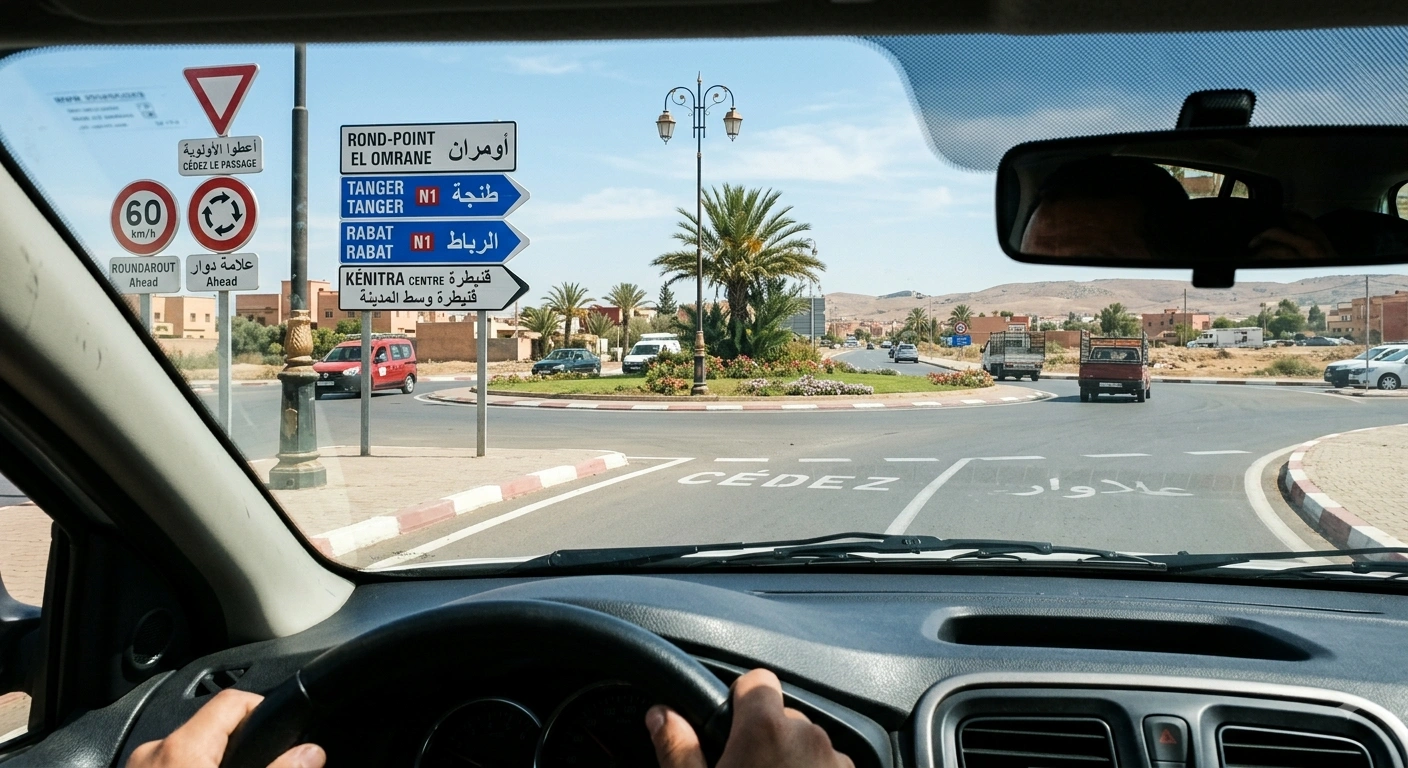
Morocco follows the "priority to the right" rule at unmarked intersections — traffic entering from your right has priority unless signs or signals say otherwise. Roundabouts don't always follow the give-way-to-the-left convention you might expect from Europe, so slow down and watch how local traffic is actually behaving rather than assuming a fixed rule applies everywhere.
Headlights, seatbelts, and phones
- Headlights: required from sunset to sunrise, and during rain, fog, or dust. Daytime use is optional but recommended for visibility.
- Seatbelts: mandatory for the driver and all passengers.
- Child seats: required for children under 12.
- Mobile phones: using a handheld phone while driving is illegal — use hands-free only.
Reading the road signs
Road signs in Morocco follow the same international (European-style) system used across most of the world, so the shapes and colors mean what you'd expect: red circles for prohibitions, red triangles for warnings, blue circles for mandatory actions. Text on signs is usually in Arabic and French, with English on major routes and important tourist signage. Stop signs are the same red octagon shape used globally, so they're recognizable even where the text is in Arabic.
Overtaking and sharing the road
On two-lane national roads, only overtake when visibility is clear and road markings allow it — trucks, buses, scooters, and even the occasional cyclist or animal can appear with little warning. Slower vehicles are common on rural roads, and locals will often use their turn signal to indicate when it's safe for you to pass; flashing headlights are frequently used as a courtesy warning about hazards or checkpoints ahead.
Putting it together for your trip
Once the basics click, driving in Morocco feels much like driving in southern Europe. For what happens if you're stopped at a checkpoint, see our guide to speed cameras, checkpoints & fines, and for the bigger picture on road safety, read is it safe to drive in Morocco as a tourist.
Ready to hit the road?
Safe Rent Agadir has well-maintained cars ready for your trip, with clear terms and airport or city-center pickup.
Book your rental carFrequently asked questions
What is the speed limit in Moroccan cities?
60 km/h is the standard urban limit, though some streets are signed lower — always follow the posted signs, which can change block to block.
Do I need to give way to the right in Morocco?
Yes, at unmarked intersections traffic from the right generally has priority, unless signs or signals indicate otherwise.
Are road signs in Morocco in English?
Mostly Arabic and French, with English shown on major routes and important tourist signage. Sign shapes and colors follow international standards, so they're easy to interpret even without the text.
Is using a phone while driving illegal in Morocco?
Yes, handheld phone use while driving is illegal. Use a hands-free system if you need to take calls.
